Gazebo by the sauna: what steam does to wood, and why this isn't a standard order
Why a sauna isn't just "standing nearby"
When a client says "I need a gazebo by the sauna," I immediately ask three questions: how many meters from the log building, where the steam from the ventilation goes, and whether they plan to glass in the gazebo. Because a gazebo by the sauna isn't a gazebo by the house with a different view. It's a structure that spends half the year standing in a steam bath under the open sky.
The main point is simple: if you build a gazebo by the sauna the same way as a regular one, the wood won't last 15 years - it'll last 5-6, and swelling will show up not after two winters, but after one.
What actually happens to the wood
The sauna releases steam into the air every time the door opens after a steam session. In summer this steam disperses quickly; in winter it settles as condensation on everything cold nearby, including the gazebo's posts and decking. The wood absorbs moisture, then dries out in the frost, then absorbs it again. These swelling-shrinking cycles are more frequent and more extreme than for regular outdoor garden furniture.
We build our gazebos from kiln-dried pine, at 16-18% moisture content. That's not an arbitrary number - at that moisture level, the wood has already gone through shrinkage and won't "move" with normal fluctuations. But by a sauna the load is higher than usual, so I build in a margin - for example, I widen the decking gap not to the standard 5 mm, but to 6-7 mm, so water from the steam drains faster and the boards don't sit wet for days.
[craftsman's story: the case of a gazebo installed too close to the sauna, where we had to take the decking apart a year later]
Distance and ventilation matter more than roof shape
People pick the roof shape, the color, the size - but the first thing that decides the fate of the structure is the distance to the sauna's log wall. I recommend at least 1.5-2 meters from a wall with a window or a ventilation outlet. If the sauna releases steam straight toward the gazebo, the wood on that side will darken and deteriorate faster than the other three sides - you can see it with the naked eye after just one season.
If space is tight and the gazebo has to sit close, I advise turning the open side away from the sauna, not toward it - which is what many people do so they can enjoy the view of the sauna.
A controversial opinion on glazing
A lot of customers want to glass in the gazebo by the sauna completely - like a winter garden next to the steam room. I don't help with that and usually talk clients out of it. A closed gazebo with no ventilation next to a steam source means condensation trapped inside with nowhere to go, settling on the frame and posts constantly rather than occasionally. An open or semi-open gazebo with proper airflow dries out between sauna sessions; a closed one doesn't. I know plenty of builders install glazing and see no problem with it, but I've seen what happens to the frame after three or four winters in those conditions, and I don't like it.
Foundation and fasteners - no cutting corners, doubly so
The 120×120 posts sit on 400×400×200 concrete blocks, with a waterproofing strip always between the block and the bottom beam. By a sauna I follow this rule even more strictly, because the ground near a sauna is often wetter than a regular plot - condensation from the sauna roof, splashes from the path after washing up. An M12 anchor through the strip into the concrete is standard, but by a sauna I sometimes add an extra strip along the perimeter of the bottom beam if the site is damp.
All the load-bearing fasteners are M12 threaded rods or 6×120 screws with brackets, galvanized or stainless steel, and every hole is pre-drilled before driving in a screw so the wood doesn't crack from moisture around the fastener. By a sauna, a crack at a fastening point isn't a cosmetic issue - it's a hole that steam and water will keep getting into for years.
Why this gazebo definitely won't be varnished
I don't use varnish outdoors at all, and by a sauna even less so. A varnish film traps moisture inside the wood if it's already gotten in through a microcrack or a chip, and it stops the wood from "breathing" between wetting-drying cycles. With constant steam from the sauna, that works against the wood, not for it. The oil with antiseptic that we use to treat every part before assembly, including the end grain, lets moisture escape while protecting the fibers at the same time. It's not a permanent solution - you'll still need to refresh the coating every 2-3 years - but the wood stays alive instead of being sealed shut.
In short
- Distance from the sauna to the gazebo - at least 1.5-2 meters, ideally with the open side facing away from the steam
- Decking gap by the sauna - slightly wider than standard, so water drains faster
- Glazing by the sauna - a controversial choice, since condensation builds up inside without ventilation
- Foundation and waterproofing - same principles as everywhere else, just stricter if the site is damp
- Never use varnish outdoors, and by the sauna this rule matters even more
- Oil with antiseptic on every part before assembly, including the end grain
If you already have a rough idea of the size and shape - check the price in the 3D configurator on our website, it shows right away how the cost changes with size and roof type.
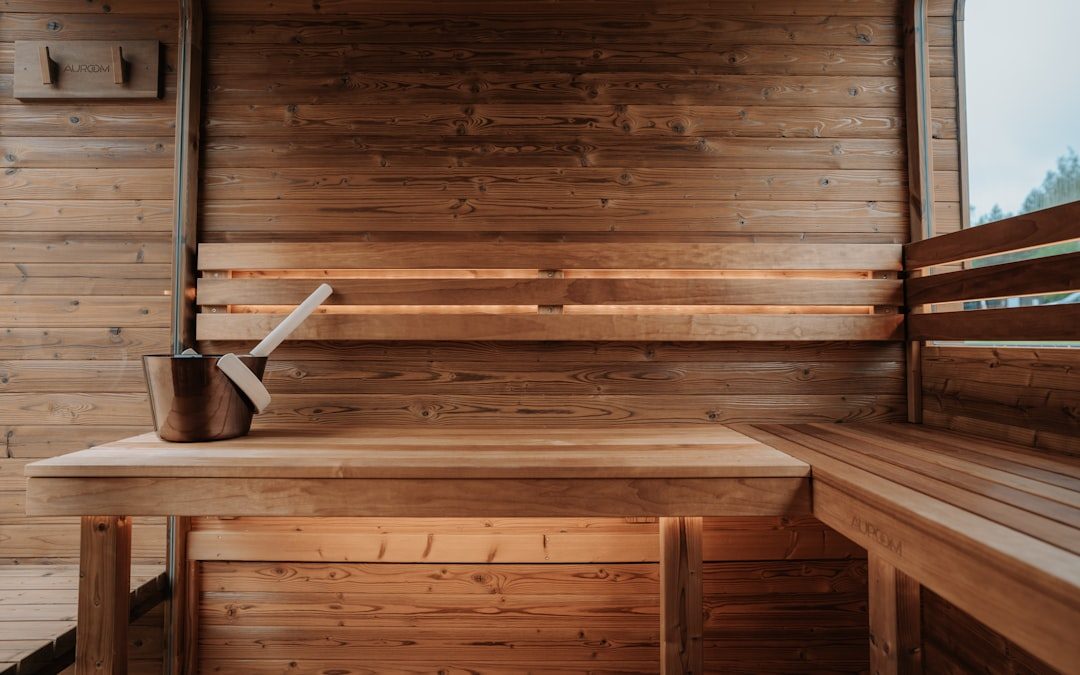
Photo: Auroom Wellness / Unsplash
Shape, size, roof, walls — see the price instantly, no calls needed.