Gazebo decking: 28mm or 45mm boards, 5mm gaps, and why boards go crosswise to joists
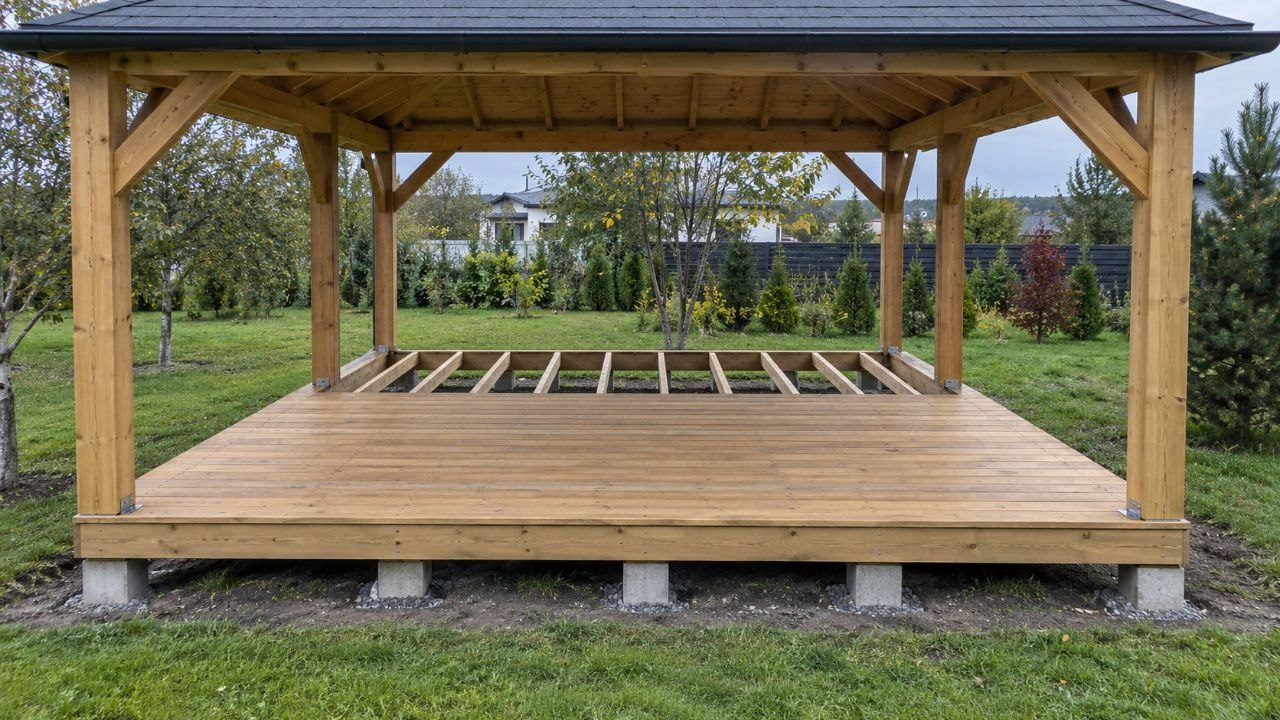
Board thickness is about joist spacing, not taste
Clients often ask me to "make the decking thicker, it'll be sturdier." The logic makes sense, but it's wrong. Deck board thickness doesn't depend on how many years you want to walk on this gazebo — it depends on the spacing of the joists underneath it. My joists are 45×145mm, spaced roughly 40–50cm apart. At that span, a 28×120mm board holds a person, a table, a group of people around that table — no sagging, no creaking after a couple of years. I've checked this more than once: gazebos have been standing three or four years, and the 28mm board stays flat and stable.
I rarely use 45mm for decking — only when the gap between joists is wider than usual, or when a client specifically wants heavier decking boards, say for a barbecue area with constant load and frequent moisture. In every other case it's an overpay and extra weight on the same structure, without any strength gain you'd actually feel underfoot.
The 5mm gap is board physics, not aesthetics
Kiln-dried pine arrives at my workshop at 16–18% moisture. Outdoors, in rain and sun, the board will keep changing size regardless — drying out and swelling with the seasons. A 5mm gap between deck boards is your allowance for that swelling. Less than that, and the boards will push against each other after a single summer and start cupping, because they have nowhere to expand into. More than 6–7mm, and it gets uncomfortable to walk on — a heel or a chair leg drops into the gap, and water pools in the gaps instead of running off as sheet flow.
I set the gap using a spacer batten of the same thickness — lay it between boards, screw down, pull it out, next board. Simple method, no measuring tape at every gap, and the spacing comes out even across the whole deck.
Why crosswise to the joists, not lengthwise or diagonal
The 45×145mm joists run in one direction, usually from one bottom rail to the other, spaced 40–50cm apart. If you lay deck boards parallel to the joists, each board rests on only one joist along its whole length — while the ends hang in the air or need an extra bottom rail under every joint. That means extra joints, extra fasteners, and spots where water pools on the cut end.
When a board runs crosswise to the joists, it rests on three or four joists at once along its length. The load spreads out, the board doesn't sag in the middle of the span, and board ends can simply be tucked under the edge trim or fascia. It's not just about strength — it's also fewer joints for water to work its way into the structure through.
About diagonal decking, I'll be honest: it looks great, especially on square gazebos, but I do it rarely and don't recommend it unless there's a real reason for it. Diagonal layout means several times more cuts and fitting work, and every angled cut is an exposed pine end grain that needs extra oil treatment — and there are several times more of those cuts on a diagonal deck than on a straight one. More exposed end grain means more spots for the wood to take on moisture. For a gazebo meant to stand for decades, I go with straight decking crosswise to the joists, even when clients ask for diagonal because of a photo they saw online.
Fasteners and treatment — what you don't see, but what matters
All deck boards, like every other part of the structure, go through oil with antiseptic before assembly at my workshop, including the end grain — it's the end grain that pine soaks up water through fastest, and that's exactly where rot starts if you skip the treatment. I don't finish decking with varnish, as a rule: varnish outdoors lasts one or two seasons, then cracks unevenly, and you can barely strip it without sanding. Oil is simpler — just wipe on a fresh coat every year or two, no need to remove the old layer.
Fasteners are galvanized or stainless steel throughout, and I pre-drill every screw hole — kiln-dried pine is drier than standard construction timber, and without a pilot hole the board can split at the end, especially near the edge where there's only 15–20mm left to the end grain.
[история мастера: случай с клиентом, который настоял на 45 мм для настила и что из этого вышло]
In short
- 28×120mm board holds up decking at 40–50cm joist spacing — 45mm is rarely needed, only for special loads
- 5mm gap is your allowance for pine swelling from moisture — less or more, and you get problems within a season
- Decking goes crosswise to joists: boards rest on several joists at once, fewer exposed end grains
- Diagonal layout looks nicer but needs several times more cuts and exposed wood ends
- Oil with antiseptic on every part, including ends — no varnish outdoors
- All fasteners galvanized or stainless, screw holes pre-drilled
If you want to see right away how the decking will look and what it'll cost at your dimensions — there's a 3D configurator on the site that calculates the price based on shape, size, and materials.
Shape, size, roof, walls — see the price instantly, no calls needed.
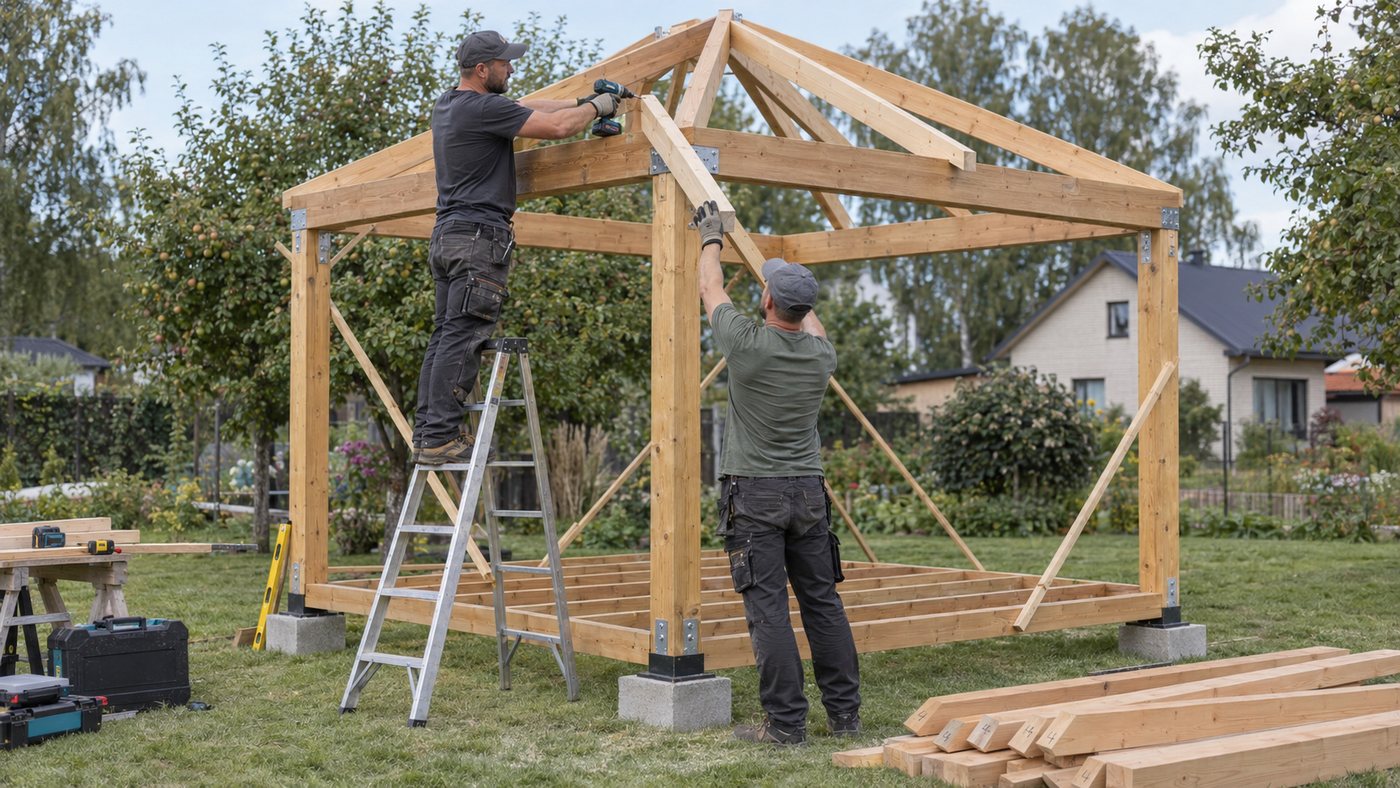 How a garden gazebo gets built on-site in a single day
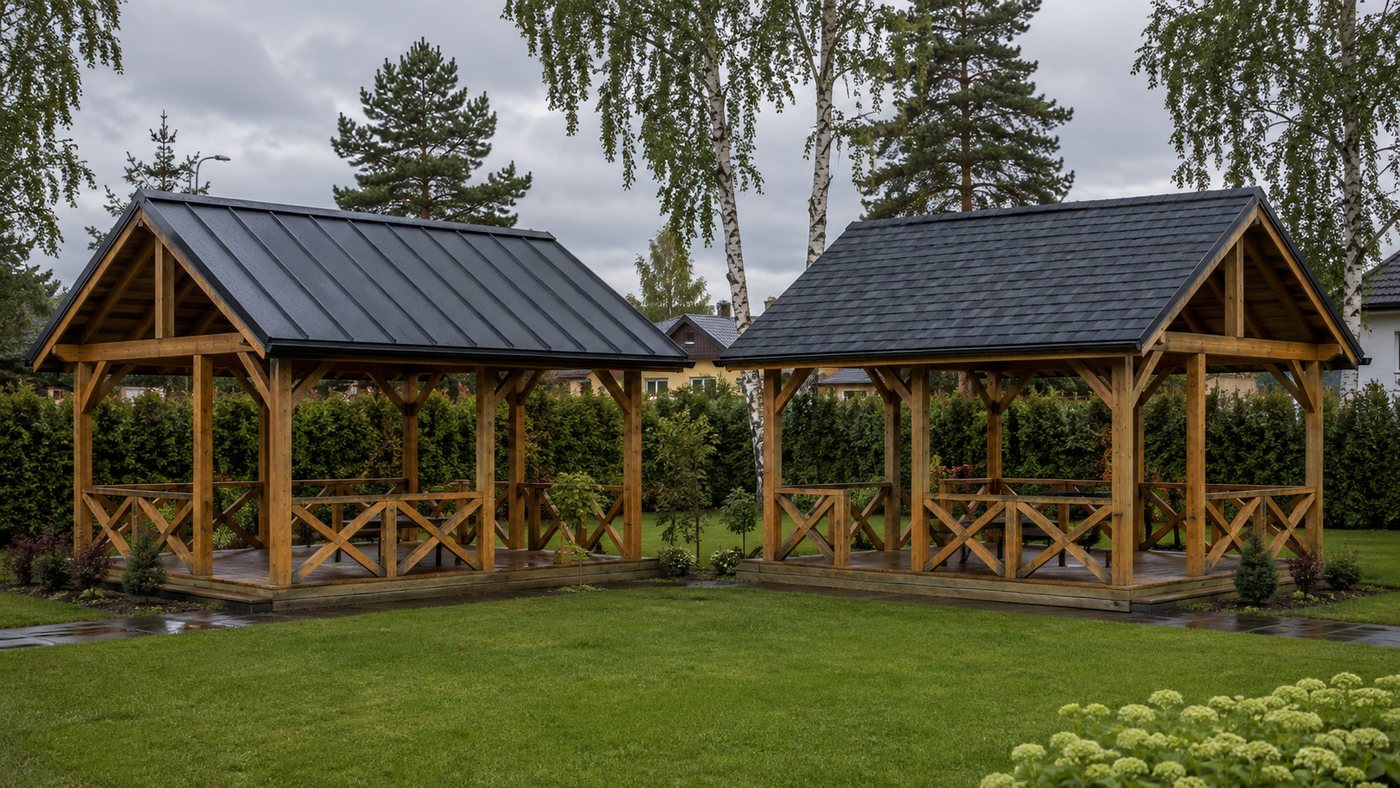 Metal or Asphalt Shingles on a Gazebo: What Happens After Ten Years
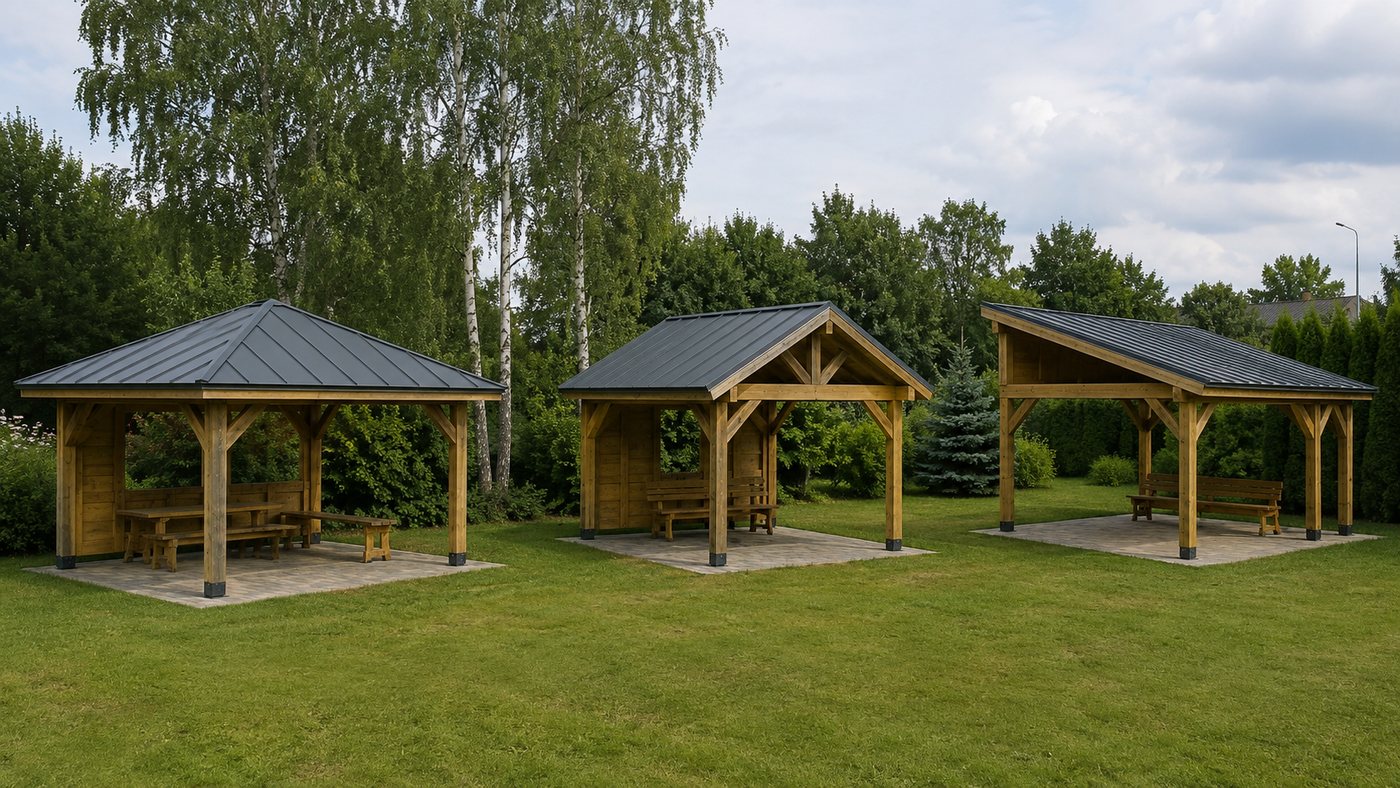 Hip, gable, or lean-to roof: what people actually choose and why